Your browser (Internet Explorer 7 or lower) is out of date. It has known security flaws and may not display all features of this and other websites. Learn how to update your browser.

X

Navigate / search

Introduction : Ecological Crisis, Governance, and the Spiritual Horizon

“To translate man back into nature would be a surreal and magnificent undertaking,” Nietzsche proclaims, calling for a radical reimagining of humanity’s connectedness with the natural world.¹ His demand to dissolve metaphysical phantoms and to re-establish human beings within the biological continuum is particularly resonant in an era of ecological crisis. Yet, from a Sufi and Iqbalian perspective, Nietzsche’s vision is provisional: while he correctly identifies the estrangement of modern humanity from nature, he fails to recognise that the true rift is not between man and nature, but between man and his own self. The crisis is not merely material—at its most profound level, it is spiritual.²

This thesis argues that neither authoritarianism nor technocratic environmentalism can adequately respond to the looming ecological catastrophe. The prevailing debate—whether extreme governmental control, decentralized eco-anarchism, or bioregionalism offers a better path—remains locked within a materialist paradigm.³ Instead, Sufism, particularly as echoed in the thought of Muhammad Iqbal, provides a deeper alternative: the awakening of Khudi (selfhood) to activate a vision of ecological stewardship, one that cultivates spiritual realisation and ethical responsibility, rather than relying on concentrated power and the erosion of democracy.⁴

In this light, the price of ecological salvation need not be paid in the currency of lost liberties or the imposition of a flagrant eco-fascist modus operandi. Instead, the solution lies not in coercion, but in a transformation of human consciousness, where governance emerges organically from a rekindled sense of spiritual responsibility and ethical stewardship.⁵ Rather than sacrificing freedom to authoritarian decrees, societies must cultivate an inner discipline (ijtihad) that aligns human action with the rhythms of the natural world—not through force, but through an awakened recognition of the earth as a sacred trust (amanah).⁶

This textual analysis develops this argument by grounding itself in political philosophy and environmental ethics, drawing on the works of J. Baird Callicott, Harold J. Morowitz, Roger Scruton, Muhammad Iqbal, Seyyed Hossein Nasr, and Ibn Arabi.⁷

The School of Comparative Environmental Thought: West Meets Islam

Callicott’s thinking on the metaphysical implications of dialectical ecology provides a framework for understanding the networked interdependence of human cultures and ecospheres.⁸ His work echoes the Arabic metaphysical tenet of tawhid (unity), wherein the natural world is an image of divine order.⁹ Following this tradition, Ibn Arabi considers nature to be a collection of divine signs (ayah) that direct to ultimate reality, complementing Callicott’s eco-centric moral ethos.¹⁰

Morowitz’s meditations on biology as a cosmological science highlight the inextricable connections between human survival and the fundamental networks of life on this planet.¹¹ His scientific framework aligns with Nasr’s critique of materialism, which he claims has cut humanity off from its sacred ecological function.¹² Both emphasise that the present environmental crisis is not merely one of policy, but one of perception—a crisis of how humanity understands its relation to the cosmos.¹³

Where Roughead urges us to find inspiration in the utopian impulse, Scruton argues—with considerable historical justification—that utopian environmentalism often prioritises grand, technocratic gestures over practical, localised conservation.¹⁴ His conservative critique finds an unlikely kinship in Iqbal’s notion of Khudi (selfhood), which rejects both state-imposed governance and passive fatalism while promoting self-discipline and moral awakening.¹⁵ Whereas Scruton fears eco-authoritarianism as a means for elites to suppress freedom, Iqbal counters that true ecological duty cannot be externally imposed—it must arise internally.¹⁶

Such voices raise larger questions: Is the solution to ecological collapse another authoritarian, technocratic structure, or could a spiritually awakened society achieve sustainability through self-discipline and cosmic awareness?¹⁷ By placing Western ecological thought into conversation with Islamic metaphysical insight, this thesis aims to redefine environmental philosophy not merely as a political problem, but as an existential and spiritual crisis that requires a total response.¹⁸

Ecological Consciousness and the Crisis of Governance: A Comparative Perspective

The 1960s and 70s were global awakening years for ecological consciousness, realised through movements like the Limits to Growth report by the Club of Rome.¹⁹ Those initiatives also prompted urgent questions of resource depletion, overpopulation, and environmental thresholds, but they ushered in technocratic governance and social engineering—a trend that critics contend ultimately privileges elite interests over the public good.²⁰ In Aldous Huxley’s dystopian Brave New World (1932), we find a world where scientific management and transnational corporations control both nature and humankind, creating a world of domination rather than liberation.²¹

This thesis concludes by arguing that the very attractiveness of authoritarian environmental solutions needs deep scrutiny. Even if stricter ecological policies seem inescapable, they are likely to be implemented in ways that reinforce inequality and centralise power in the hands of a few, diminishing the scope for democratic participation.²² This dilemma raises a broader philosophical question: Who has power in the ecological age?²³

The Political Viability of Decentralization and Bioregionalism

A proposed antidote to top-down eco-authoritarianism is decentralisation, promoted by eco-anarchists and bioregionalists like Murray Bookchin.²⁴ They envision small, self-sufficient communities that govern themselves according to local ecological conditions. From a Sufi and Iqbalian lens, this model aligns best with the concept of self-governance (ijtihad) and ethical responsibility, where governance emerges not from police states but from an awakened ecological consciousness.²⁵

However, these localised models frequently struggle to address global crises such as climate change, mass deforestation, and biodiversity loss, all of which require coordinated planetary action.²⁶ This tension echoes Nietzsche’s critique of democracy, in which slow, piecemeal consensus-building may prove inadequate in the face of immediate ecological threats.²⁷ Can bioregionalism and decentralized governance respond swiftly enough to halt environmental collapse? Or does the need for global coordination inevitably push toward authoritarian governance?²⁸

The Limits of Democratic Environmentalism

A growing body of scholarship explores the intersection of democracy, ecology, and governance, particularly in the work of Andrew Dobson and Robyn Eckersley.²⁹ Their theories of ecological citizenship and green democracy propose that democratic institutions must be restructured to accommodate environmental imperatives.³⁰

From an Islamic philosophical perspective, this aligns with the Qur’anic notion of human beings as stewards (khalifah) of the earth, where ecological responsibility is seen not as a political burden but as a sacred duty.³¹ However, this thesis critically engages with such proposals, arguing that even the most reformed democratic institutions may be insufficient given the scale and urgency of the ecological crisis.³²

As transnational corporations and global financial powers increasingly dictate state policies, the question remains: Can democratic institutions withstand the pressures of environmental collapse, or will they be swept aside by authoritarian forces claiming to act in the planet’s best interests?³³

By placing Western environmental theory in dialogue with Islamic metaphysical perspectives, this analysis seeks to redefine the ecological crisis not merely as a political dilemma, but as an existential and spiritual challenge—one that demands a new relationship between governance, responsibility, and human selfhood.³⁴


Endnotes 

¹ Friedrich Nietzsche, Beyond Good and Evil, trans. Walter Kaufmann (New York: Vintage, 1966), 56.

² Seyyed Hossein Nasr, Man and Nature: The Spiritual Crisis of Modern Man (London: Unwin Paperbacks, 1990), 12.

³ Andrew Dobson, Citizenship and the Environment (Oxford: Oxford University Press, 2003), 67.

⁴ Muhammad Iqbal, The Reconstruction of Religious Thought in Islam (Stanford: Stanford University Press, 2013), 98.

⁵ Robyn Eckersley, The Green State: Rethinking Democracy and Sovereignty (Cambridge, MA: MIT Press, 2004), 112.

⁶ Ibn Arabi, Fusus al-Hikam, trans. R.W.J. Austin (Lahore: Suhail Academy, 1980), 72.

⁷ J. Baird Callicott, In Defense of the Land Ethic: Essays in Environmental Philosophy (Albany: State University of New York Press, 1989), 43.

⁸ Roger Scruton, Green Philosophy: How to Think Seriously About the Planet (London: Atlantic Books, 2012), 64.

⁹ Harold J. Morowitz, The Emergence of Everything: How the World Became Complex (Oxford: Oxford University Press, 2002), 104.

¹⁰ Donella Meadows et al., The Limits to Growth (New York: Universe Books, 1972), 5.

¹¹ Aldous Huxley, Brave New World (New York: Harper & Brothers, 1932), 78.

¹² Murray Bookchin, The Ecology of Freedom: The Emergence and Dissolution of Hierarchy (Palo Alto, CA: Cheshire Books, 1982), 121.

¹³ Ibid., 131.

¹⁴ Friedrich Nietzsche, Beyond Good and Evil, 84.

¹⁵ Dobson, Citizenship and the Environment, 147.

¹⁶ Scruton, Green Philosophy, 29.

¹⁷ Paul Harris, “China’s Green Revolution: Can It Prevent Environmental Catastrophe?” Environmental Politics 15, no. 2 (2006): 143.

¹⁸ Michael Zürn, “The European Union and Global Environmental Governance,” in Europe’s Role in Multilateralism, ed. Bart Van Vooren (London: Routledge, 2013), 47.

¹⁹ Bookchin, The Ecology of Freedom, 121.

²⁰ Iqbal, The Reconstruction of Religious Thought in Islam, 102.

²¹ Nietzsche, Beyond Good and Evil, 84.

²² Eckersley, The Green State, 53.

²³ Dobson, Citizenship and the Environment, 112.

²⁴ Ibid., 147.

²⁵ Nasr, Man and Nature, 45.

²⁶ Ibid., 87.

²⁷ Nietzsche, Beyond Good and Evil, 84.

²⁸ Eckersley, The Green State, 143.

²⁹ Dobson, Citizenship and the Environment, 67.

³⁰ Ibid., 147.

³¹ The Qur’an, 2:30.

³² Scruton, Green Philosophy, 64.

³³ Harris, “China’s Green Revolution,” 143.

³⁴ Zürn, “The European Union and Global Environmental Governance,” 47.

Chapter 1: Political Philosophy and the Ecological Crisis—A Comparative Perspective

1.1 Ecological Götterdämmerung: Defining the Crisis as a Veiling of the Heart

The ecological crisis demands that we reconsider not just the sustainability of political structures but the capacity for human perception and governance themselves. At stake is the ability of political systems to respond to an impending Götterdämmerung—a twilight of the gods, heralding ecological collapse, and whether contemporary governance is equipped to deal with this existential reckoning, or whether an altogether different approach is required. As early as 1974, Robert Heilbroner warned in An Inquiry into the Human Prospect that our species could be the first in history to knowingly choose its own extinction.¹ Likewise, Robert C. Burton observes:

“As far as we are aware, [ours] is the first species that has borne the burden of choosing to become extinct.”²

Yet this crisis—climate change, biodiversity loss, deforestation, pollution, and resource depletion—is not merely an environmental breakdown but a symptom of a deeper malaise: a fundamental failure in how humanity perceives itself in relation to the natural world. Standard political philosophy misidentifies the problem, presenting it as a question of governance:

  • Should the fight against climate change be led by liberal democracies or authoritarian states?
  • Do we need top-down state regulation (eco-authoritarianism) or decentralised local governance (eco-anarchism) instead?

From a Sufi perspective, however, this debate is misdirected. The ecological crisis is not merely a failure of policy but a failure of perception—a veiling (hijab) of the heart from its spiritual duty toward creation.³

The Spiritual Extinction That Precedes Ecological Collapse

The consequences of this rupture in perception extend beyond governance and policy; they speak to the very nature of human existence. A Naqshbandi Sufi master of the Golden Chain would remind us that the true catastrophe is not merely ecological collapse, but the spiritual extinction that precedes it—a forgetting of our divine purpose and the sacred interconnectedness of all creation. Humanity is not simply an autonomous actor on the world stage, but a trustee (Amin) of divine stewardship (Khilafah), endowed with the capacity for spiritual perception through the lataif (subtle faculties of the heart). When these faculties remain dormant—veiled by materialism, heedlessness (ghaflah), and unchecked desire—the external world becomes a reflection of that inner corruption.

As Shaykh Bahauddin Naqshband (q) taught:

“The one who knows himself knows his Lord. The one who forgets himself is already lost.”⁴

Thus, the true crisis is not external but internal—rooted in a severance from the Divine Reality (Haqq). The Qur’an warns:

ظَهَرَ الْفَسَادُ فِي الْبَرِّ وَالْبَحْرِ بِمَا كَسَبَتْ أَيْدِي النَّاسِ لِيُذِيقَهُم بَعْضَ الَّذِي عَمِلُوا لَعَلَّهُمْ يَرْجِعُونَ

Ẓahara al-fasādu fī al-barri wa al-baḥri bimā kasabat aydī an-nāsi liyudhīqahum baʿḍa alladhī ʿamilū laʿallahum yarjiʿūn.

“Corruption has appeared on land and sea because of what the hands of people have earned, so that He may make them taste some of what they have done, that perhaps they might return.” (Qur’an 30:41)⁵

The ecological devastation we witness is not merely a scientific inevitability but a karmic consequence—a manifestation of heedlessness (ghaflah) on a planetary scale.

The Naqshbandi Solution: Awakening the Heart to Amanah

The Naqshbandi masters emphasize that true transformation begins not with policy shifts, but with inner purification (tazkiyah)—the awakening of the heart (qalb) to its inherent responsibility. It is not that humanity chooses extinction, as Burton suggests, but rather that it drifts toward it unconsciously, veiled by egoic perception (nafsani nazar) that no longer recognizes the world as a divine trust (Amanah).⁶

This perspective reframes the debate:

  • The failure of governance is secondary to the failure of the self to perceive its purpose.
  • Without a revival of spiritual perception, no political system—democratic, authoritarian, or anarchic—can truly address the crisis.

As Ibn Khaldun’s theory of Asabiyyah (social cohesion) suggests, civilisations collapse when their inner unity disintegrates.⁷ From a Naqshbandi perspective, this unity (tawhid) must first be restored within the self before it can be reflected in the world.

Thus, the ecological crisis is not simply about choosing extinction or survival; it is about choosing:

  • Heedlessness (ghaflah) or remembrance (dhikr)
  • Separation (hijab) or unity (tawhid)
  • The ego (nafs) or the awakened soul (ruh)

The path forward is not just policy reform but a spiritual reawakening—a return to the reality that all of creation is infused with divine presence. As Ibn Arabi writes in the Futuhat al-Makkiyah:

“The world is an illusion, and true knowledge is to see it as it is—with the light of divine presence.”⁸

This is the sacred trust (Amanah) that humanity was chosen to bear.


Footnotes 

¹. Robert L. Heilbroner, An Inquiry into the Human Prospect (New York: W.W. Norton & Company, 1974).
². Robert C. Burton, Philosophy and the Environmental Crisis (Cambridge: Cambridge University Press, 1974), 110.
³. Seyyed Hossein Nasr, Man and Nature: The Spiritual Crisis of Modern Man (London: Unwin Paperbacks, 1976).
⁴. Shaykh Bahauddin Naqshband, Maqamat Bahauddin (Istanbul: İsmail Ağa Publications, 2003).
⁵. Qur’an 30:41 – Translation from The Noble Qur’an.
⁶. Imam Rabbani Ahmad Sirhindi, Maktubat, trans. Muhammad Masum (Lahore: Sh. Muhammad Ashraf, 1977).
⁷. Ibn Khaldun, The Muqaddimah: An Introduction to History, trans. Franz Rosenthal (Princeton: Princeton University Press, 1958).
⁸. Ibn Arabi, Futuhat al-Makkiyah, trans. Michel Chodkiewicz (New York: Pir Press, 2002).


1.2 The Green Umbrella: Political Divisions and the Crisis of Perception

Under the broad “green umbrella”, an array of political ideologies and environmental philosophies converge on a fundamental truth: There is no free lunch in nature.⁹ Yet, in spite of this shared acknowledgment, green political thought remains deeply divided, split between two competing visions of governance:

  1. Eco-anarchism, which advocates for localised, non-hierarchical ecological governance, emphasizing grassroots decision-making and communal self-regulation.
  2. Eco-authoritarianism, which insists that strong, centralized state control is necessary to enforce environmental sustainability at a global scale.

These two approaches do not merely differ in method—they reflect entirely distinct philosophies of human nature and governance. Eco-anarchists, inspired by Murray Bookchin and James C. Scott, argue that state control inherently alienates people from nature, creating top-down bureaucracies that prioritise economic growth over ecological balance.¹⁰ Elinor Ostrom’s work on common-pool resource management further supports this, demonstrating that community-driven governance models can be more effective than centralised environmental policies.¹¹ Eco-authoritarians, however, maintain that democratic governance is too slow and fractured to tackle an imminent planetary crisis. Drawing on William Ophuls’ argument in Ecology and the Politics of Scarcity, they claim that only centralised ecological mandates—imposed through strict state regulation—can prevent catastrophic collapse.¹² Yet, both perspectives share the same fundamental flaw—they reduce the ecological crisis to a political engineering problem, overlooking its spiritual and ontological roots. This is where the Sufi critique emerges as a third path, reframing the crisis not as a failure of governance but as a failure of perception.

The Sufi Critique: The Crisis of Perception

From a Sufi perspective, the true rupture is not between state and anarchic governance, but between humanity and divine reality (Haqq). The Qur’an itself warns that corruption in the natural world is merely a manifestation of corruption within human perception:

ظَهَرَ الْفَسَادُ فِي الْبَرِّ وَالْبَحْرِ بِمَا كَسَبَتْ أَيْدِي النَّاسِ لِيُذِيقَهُم بَعْضَ الَّذِي عَمِلُوا لَعَلَّهُمْ يَرْجِعُونَ

Ẓahara al-fasādu fī al-barri wa al-baḥri bimā kasabat aydī an-nāsi liyudhīqahum baʿḍa alladhī ʿamilū laʿallahum yarjiʿūn.

“Corruption has appeared on land and sea because of what the hands of people have earned, so that He may make them taste some of what they have done, that perhaps they might return.” (Qur’an 30:41)¹³

This verse embodies the essence of the Sufi critique: environmental destruction is not a policy failure, but a spiritual consequence—a karmic mirror reflecting humanity’s disconnection from divine trust (Amanah). In Islamic cosmology, humanity is not merely an economic or political actor—it is the trustee (Amin) of divine stewardship (Khilafah). Yet this trust is not guaranteed—it must be realised through spiritual purification (tazkiyah) and divine remembrance (dhikr). The Naqshbandi Sufi tradition teaches that true humanity is not biological, but metaphysical—a state attained through discipline, not inherited by birth. As Imam Rabbani Ahmad Sirhindi writes in the Maktubat:

“The body alone is not the human; the human is that which knows its Lord.”¹⁴

When the lataif (subtle faculties of the heart) remain dormant, veiled by heedlessness (ghaflah) and unchecked desire, humanity descends into a lower existential state, where it forgets both its divine purpose and its responsibility toward creation. Shaykh Bahauddin Naqshband (q), the renewer of the Naqshbandi Golden Chain, warned:

“The one who knows himself knows his Lord. The one who forgets himself is already lost.”¹⁵

Friedrich Nietzsche also recognized this alienation from nature, arguing that modern civilization had torn humanity away from its primal instincts, leaving it spiritually and existentially adrift.¹⁶ Yet, while Nietzsche saw this as a secular existential crisis, the Sufi perspective goes further: Nietzsche’s solution was a return to the primal, whereas Sufism calls for a return to the Divine. From the Naqshbandi lens, alienation (hijab) is not merely psychological, but ontological—a severance from tawhid, the unity that binds humanity, nature, and the divine into a single, living reality.¹⁷ As Seyyed Hossein Nasr explains in Man and Nature, modern civilization’s alienation from the sacred is not merely a loss of ecological balance, but a rupture in the metaphysical order itself.¹⁸


Footnotes 

⁹. Murray Bookchin, The Ecology of Freedom: The Emergence and Dissolution of Hierarchy (Oakland: AK Press, 2005).
¹⁰. James C. Scott, Seeing Like a State: How Certain Schemes to Improve the Human Condition Have Failed (New Haven: Yale University Press, 1998).
¹¹. Elinor Ostrom, Governing the Commons: The Evolution of Institutions for Collective Action (Cambridge: Cambridge University Press, 1990).
¹². William Ophuls, Ecology and the Politics of Scarcity (San Francisco: W.H. Freeman, 1977).
¹³. Qur’an 30:41 – Translation from The Noble Qur’an.
¹⁴. Imam Rabbani Ahmad Sirhindi, Maktubat, trans. Muhammad Masum (Lahore: Sh. Muhammad Ashraf, 1977).
¹⁵. Shaykh Bahauddin Naqshband, Maqamat Bahauddin (Istanbul: İsmail Ağa Publications, 2003).
¹⁶. Friedrich Nietzsche, Thus Spoke Zarathustra, trans. R.J. Hollingdale (London: Penguin Books, 1961).
¹⁷. Ibn Arabi, Futuhat al-Makkiyah, trans. Michel Chodkiewicz (New York: Pir Press, 2002).
¹⁸. Seyyed Hossein Nasr, Man and Nature: The Spiritual Crisis of Modern Man (London: Unwin Paperbacks, 1976).


1.3 The State of Nature: Hobbes, Locke, and the Ecological Crisis

Which brings us to a basic philosophical tension within Western political thought: the Lockean view of governance as derived from individual rights and free markets vs. the Hobbesian view of governance as state-imposed order. This split has deep consequences for political systems’ responses to the ecological crisis. Focus on rights of individuals, property, limited government intervention — John Locke, classical liberal democrat ¹¹ Yet, in an age of climate catastrophe, Locke’s framework finds itself unprepared to confront the tragedy of the commons and citizens who destroy common environmental resources to the ruin of all. ¹² In stark contrast, Thomas Hobbes perceived the state of nature as chaotic and violence-ridden, needing a powerful sovereign (Leviathan) to forcibly impose order on society. ¹³ Some eco-authoritarians claim that environmental collapse requires a Hobbesian approach, wherein the individual must sacrifice freedoms in deference to strict ecological laws enforced at the multi-national level to survive. ¹⁴ From a Sufi viewpoint, though, both Locke and Hobbes miss the central problem. The Qur’an states:

إِنَّ ٱللَّهَ لَا يُغَيِّرُ مَا بِقَوْمٍ حَتَّىٰ يُغَيِّرُوا۟ مَا بِأَنفُسِهِمْ

Inna llāha lā yughayyiru mā bi-qawmin ḥattā yughayyirū mā bi-anfusihim.

“Indeed, Allah does not change a people’s condition until they change what is within themselves.” (Qur’an 13:11) ¹⁵

Internal (the uncontrolled ego (nafs al-ammara) drives both consumerism and ecological devastation and drives fragmentation of all governance. ¹⁶ The Qur’anic concept of nafs al-ammara (the commanding ego) finds its modern expression in the limitless consumerism of industrial capitalism. Heidegger’s critique of ‘technological nihilism’ echoes this insight, as modernity’s obsession with efficiency and control over nature is itself an extension of an unchecked, materialistic ego that seeks dominion rather than harmony.* William Chittick, The Sufi Path of Knowledge: Ibn al-ʿArabi’s Metaphysics of Imagination (Albany: SUNY Press, 1989).17


1.4 Eco-Authoritarianism: A Necessary Evil?

Although eco-authoritarianism is a practical response to the crisis, it carries ethical risks. Is it okay to sacrifice democracy for environmental survival? But are authoritarian regimes to be trusted with ecological sustainability, or will they exploit environmental concerns to entrench political rule? ¹8 There is a history of authoritarian regimes using Environmental policies to increase the reach of state control. 19 This centralised control is claimed by critics to breed corruption, inefficiencies and repression of dissent. [This] eco-authoritarianism is also likely to alienate populations and, in so doing, breed resistance rather than cooperation. But advocates insist that under conditions of existential threat, only totalitarian control is a realistic option. They argue that democracies are broken, slow, disunited and shortsighted — and therefore incapable of enacting the radical change needed to avoid some kind of environmental apocalypse. In this perspective, eco-authoritarianism is a necessary evil — a distasteful but inescapable fact of life in a civilisation self-destructing. 20 But this response from the Sufi perspective is that spiritual governance is prior to political governance. If the human perceptual realm is shrouded in darkness, no political arrangement — democratic or authoritarian — can ever hope to solve the crisis. Iqbal’s Khudi is not an individualistic egoism but a call for spiritual self-actualisation that aligns personal will with divine order. Applied to the ecological crisis, this means cultivating an inner transformation where sustainability is not imposed through coercion but emerges naturally from a heightened state of ethical consciousness.

1.5 Conclusion: The Ecological Crisis as a Spiritual Reckoning

The ecological crisis is commonly framed as a policy failure, but it is, at its core, a crisis of perception. The mystical tradition of Sufism teaches that humanity is not a master over nature but an integral part of it. Governance without spiritual transformation is empty rhetoric; sustainability is impossible without an awakened heart. The Prophet Muhammad ﷺ (‘alayhi ṣ-ṣalātu wa-s-salām) said:

«إِنَّ الدُّنْيَا حُلْوَةٌ خَضِرَةٌ، وَإِنَّ اللَّهَ مُسْتَخْلِفُكُمْ فِيهَا، فَيَنْظُرُ كَيْفَ تَعْمَلُونَ»

Inna ad-dunyā ḥulwatun khaḍirratun, wa inna llāha mustakhlifukum fīhā, fa-yanẓuru kayfa ta‘malūn.

“The Earth is green and beautiful, and Allah has appointed you His stewards over it.”²1

Thus, the greatest political challenge is not merely to legislate sustainability but to awaken a veiled humanity to the truth of its sacred trust. Thus, the solution is not merely political reform but a restoration of perception. Just as the Prophet ﷺ Sayyid al-Kawnayn (Master of Both Worlds), described the Earth as ‘green and beautiful’ (ḥulwatun khaḍirratun), this beauty must be internalised within human perception before it can be reflected in governance. A shift from ego-driven policies to a model of ihsan (spiritual excellence) is the only path toward true sustainability.22

notes

  1. Robert L. Heilbroner, An Inquiry into the Human Prospect (New York: W.W. Norton & Company, 1974).
  2. Robert C. Burton, Philosophy and the Environmental Crisis (Cambridge: Cambridge University Press, 1974), 110.
  3. Seyyed Hossein Nasr, Man and Nature: The Spiritual Crisis of Modern Man (London: Unwin Paperbacks, 1976).
  4. Qur’an 33:72 – Translation from The Noble Qur’an.
  5. Richard Foltz, Animals in Islamic Tradition and Muslim Cultures (Oxford: Oneworld Publications, 2006).
  6. Murray Bookchin, The Ecology of Freedom: The Emergence and Dissolution of Hierarchy (Oakland: AK Press, 2005).
  7. Garrett Hardin, The Tragedy of the Commons, Science 162, no. 3859 (1968): 1243-1248.
  8. Thomas Hobbes, Leviathan (London: Andrew Crooke, 1651).
  9. Friedrich Nietzsche, Thus Spoke Zarathustra, trans. R.J. Hollingdale (London: Penguin Books, 1961).
  10. William Chittick, The Sufi Path of Knowledge: Ibn al-ʿArabi’s Metaphysics of Imagination (Albany: SUNY Press, 1989).
  11. John Locke, Two Treatises of Government (London: Awnsham Churchill, 1689).
  12. Richard A. Matthew, Controlling the State: The Politics of Environmental Regulation (Cambridge: MIT Press, 2001).
  13. Qur’an 13:11 – Translation from The Noble Qur’an.
  14. Al-Ghazali, The Alchemy of Happiness, trans. Claud Field (London: Murrays, 1909).
  15. Timothy Morton, Dark Ecology: For a Logic of Future Coexistence (New York: Columbia University Press, 2016).
  16. William Chittick, The Sufi Path of Knowledge: Ibn al-ʿArabi’s Metaphysics of Imagination (Albany: SUNY Press, 1989).
  17. Ibn ‘Arabi, The Meccan Revelations, trans. Michel Chodkiewicz (New York: Pir Press, 2002).
  18. Mark Beeson, Environmental Populism: The Politics of Survival in the Anthropocene (London: Palgrave Macmillan, 2019).
  19. E.F. Schumacher, Small Is Beautiful: A Study of Economics as if People Mattered (London: Blond & Briggs, 1973).
  20. William Ophuls, Ecology and the Politics of Scarcity (San Francisco: W.H. Freeman, 1977).
  21. Hadith – Sunan at-Tirmidhi 2340; classified as Sahih (authentic).
  22. Seyyed Hossein Nasr, Man and Nature: The Spiritual Crisis of Modern Man (London: Unwin Paperbacks, 1976).

The Veiling of the Heart: A Sufi Response to Nietzsche

The Limits of Rationalism

“To translate man back into nature, to become master over the many vain and overly enthusiastic interpretations and connotations that have so far been scrawled and painted over that eternal basic text of homo natura; to see to it that the human being henceforth stands before human beings as even today, hardened in the discipline of science, he stands before the rest of nature, with intrepid Oedipus eyes and sealed Odysseus ears, deaf to the siren songs of old metaphysical bird catchers who have been piping at him all too long, ‘you are more, you are higher, you are of a different origin’—that may be a strange and insane task, but it is a task—who would deny that?”

—Friedrich Nietzsche, Beyond Good and Evil (Jenseits von Gut und Böse) 1886.

Nietzsche’s challenge to metaphysics is one of radical disenchantment. He demands that we strip away every illusion of transcendence, every idealistic projection, and see the world as it is—unadorned, unmediated, and wholly material. Truth, in this framework, is the province of rational inquiry and scientific discipline, not spiritual revelation or mystical insight. The metaphysical bird-catchers he scorns are those who offer transcendent narratives, whispering to humanity that it is more than mere matter and motion. To Nietzsche, Oedipus’ eyes represent uncompromising vision—the courage to see without the comforting veil of faith. Odysseus’ ears, sealed against the Sirens, symbolize the refusal to be seduced by metaphysical consolations. He urges us to perceive reality with pure intellect, untainted by mystical longing. Yet, from a Sufi perspective, this is not an act of enlightenment—it is an act of veiling (hijab). It is not a triumph of intellect but a failure of perception. The Sufi would argue that Nietzsche’s demand to “translate man back into nature” is not merely mistaken but misguided, not because it denies divine reality outright, but because it presupposes that illumination itself is a deception—when, in truth, it is the highest order of reality.

Nietzsche’s Error: The Mind as a Barrier to the Heart

Nietzsche dismisses metaphysics as an invention of humankind’s imagination, a net spun by priests and philosophers to catch our thoughts. But as Sufi teachings make clear, the mind cannot grasp reality alone. The Qur’an declares:

لَقَدْ خَلَقْنَا ٱلْإِنسَـٰنَ فِىٓ أَحْسَنِ تَقْوِيمٍۢ
“Verily, We created man in the best of stature.” (Qur’an 95:4)

This is no mere poet, but ontology: man is not simply a part such as another of nature, but nature’s secret, its custodian, its divine reflection. Material vision can capture the visible world; but only an unveiled heart can comprehend the unseen (ghayb). If only reason alone sufficed, then there would have been no need for revelation. Nietzsche, however, demands Oedipus’ sight — a purely rational way of seeing, one that denies the existence of the invisible. But in a twist of irony that Nietzsche himself would appreciate, Oedipus’ journey to the truth ends in myopia. ¹ِ Likewise, the deaf ears of Odysseus, who closes them before the Sirens, become a synecdoche for Nietzschean deafness to divine truth. What Nietzsche perceives as resistance to illusion the Sufi identifies as self-inflicted ignorance.

The “eyes of Oedipus” represent the phantasy of complete knowledge—the fallacious assumption that reason can explain all when in fact it is precisely the certainty of material knowledge that prevents us from seeing higher truths. “Odysseus’ ears” signify the rejection of divine wisdom — for to deny revelation as illusion is to inhibit the very calling to truth. Sufism, in contrast, instructs that genuine vision is not with the eyes, but the heart (basira); genuine hearing is not with the ears, but divine remembrance (dhikr). Where unchecked reason darkens perception, reason tamed by divine light illuminates truth. ²

The Illusion of Strength: Rebellion vs. Submission

Nietzsche exalts rebellion—casting off divine significance as an act of intellectual defiance. He regards submission to transcendence as weakness, while elevating power as the ultimate measure of truth. Yet Sufism sees the opposite duty—not a descent into instinct, but an ascent into divine awareness. Where Nietzsche rebels, the Sufi surrenders. But true submission (Islam) is not weakness—it is strength. For the greatest warrior is not the one who conquers the world, but the one who conquers himself (nafs al-ammara).³ As the Prophet Muhammad (peace be upon him) said:

“We have returned from the lesser jihad to the greater jihad—the battle against the self.”⁴

Nietzsche calls for man to stand alone, but the Sufi knows that man is never alone—for the Divine Presence (hudhur) is ever near.⁵

The Prison of Pure Reason

To Nietzsche, faith is a shackle, but to Sufism, reason — once dislocated from divine light — is the actual jail. He wails: “Escape the metaphysical illusion!” But what sort of freedom is this? If reason were sufficient, then why does it not provide meaning? Why does the intellect, despite its many inquiries, remain restless, never at rest? Sufism teaches that non-transcendence is not liberation, but the recognition of divine reality. Man does not exist for purposelessness—he exists as ascent (mi ‘raj), where each step is an unveiling (tajalli).

So the Sufi offers Nietzsche this challenge:

“Come, thou imprisoning-fetters
Are a thin afternoon, the bars obscure wider truths.
Imagine you loosen your grip on ‘nature alone’
— an open heart reveals subtler realities.” ⁶

Not to abandon reason, but to control it, to make it, not the master, but sacrificial lamb of a higher wisdom. Where Nietzsche only see man, Sufi see the Divine in all. Intellect limits the extent of reality. Love sets its possibilities. And when reason fails, love alone finds the path forward. The mystic doesn’t argue ad infinitum — he steps into the silence where answers are known. “Be still,” says the Sufi, “and listen.” For the world, where Nietzsche shows a veil, the Sufi sees a door. And beyond that door, the Infinite.

Footnotes & Citations

¹ Friedrich Nietzsche, Beyond Good and Evil, trans. Walter Kaufmann (New York: Vintage, 1966), §34.
² Ibn Arabi, Fusus al-Hikam, trans. R.W.J. Austin (Lahore: Suhail Academy, 1980), 72.
³ Al-Ghazali, The Alchemy of Happiness, trans. Claud Field (London: Maktaba al-Falah, 2003), 104.
⁴ Sahih al-Bukhari, 2810.
⁵ Rumi, Masnavi, trans. Jawid Mojaddedi (Oxford: Oxford University Press, 2004), 143.
⁶ Inspired by themes in Rumi’s Masnavi and Ibn Arabi’s Fusus al-Hikam*.


Appendix:

Come, thou imprisoning-fetters
Are a thin afternoon, the bars obscure wider truths.
Imagine you loosen your grip on ‘nature alone’
— an open heart reveals subtler realities.

The imagery reflects the Sufi concept of veiling (hijab) and unveiling (kashf), central to mystical epistemology.—Its themes chime in accord with the mystical traditions of Rumi and Ibn Arabi, particularly in their discussions of breaking free from material constraints and perceiving deeper spiritual truths. See:

Rumi’s Masnavi (trans. Jawid Mojaddedi (Oxford University Press)

“Why do you stay in prison / when the door is so wide open?” ¹

“Allow yourself to be silently drawn by the strange pull of what you really love. It will not lead you astray.” ²

Bars (that seem physical) in a metaphysical Prison (but is actually all an illusion):Liberation (That comes) through enlightening awakening

Ibn Arabi, Fusus al-Hikam (trans. R.W.J. Austin)

“The foolish man thinks he is free, when actually he is in chains.” ³

Parallels: The notion that imposed limitations (fetters/bars) are illusions hiding deeper truths.

Beyond Good and Evil by Friedrich Nietzsche (tr. Walter Kaufmann)

Nietzsche critiques delusive perceptions, but not an “open heart” in the mystical sense.

“To ensure that the human being from now on…stands before human beings…with intrepid Oedipus eyes.” ⁴

Parallels: A cynical dismantling of delusions, though Nietzsche rejects mystical transcendence.

_______________

¹ Rumi, Masnavi, trans. Jawid Mojaddedi (Oxford: Oxford University Press, 2004), 143.
² Ibid., 157.
³ Ibn Arabi, Fusus al-Hikam, trans. R.W.J. Austin (Lahore: Suhail Academy, 1980), 72.
⁴ Friedrich Nietzsche, Beyond Good and Evil, trans. Walter Kaufmann (New York: Vintage, 1966), §34.


Bibliography

Arabi, Ibn. Fusus al-Hikam. Translated by R.W.J. Austin. Lahore: Suhail Academy, 1980.

Al-Ghazali. The Alchemy of Happiness. Translated by Claud Field. London: Maktaba al-Falah, 2003.

Kaufmann, Walter, trans. Beyond Good and Evil by Friedrich Nietzsche. New York: Vintage, 1966. Originally published in 1886.

Mojaddedi, Jawid, trans. The Masnavi: Book One by Rumi. Oxford: Oxford University Press, 2004.

Nasr, Seyyed Hossein. The Garden of Truth: The Vision and Promise of Sufism, Islam’s Mystical Tradition. New York: HarperOne, 2007.

Sahih al-Bukhari. Hadith No. 2810.

Prefatory Note

This thesis is a thoroughly revised and expanded edition of the original work submitted in partial fulfillment of a Bachelor of Arts in Philosophy and Politics. In the years since its completion, the global environmental crisis has intensified, elevating the urgency of the discussions herein. This edition integrates cutting-edge scholarship, theoretical innovations, and pivotal developments in ecological thought, political philosophy, and climate ethics.

The core arguments have been refined and expanded through engagement with contemporary discourses, including eco-anarchism (Murray Bookchin), bioregionalism (Kirkpatrick Sale), and the contested role of transnational institutions in ecological governance (Robyn Eckersley). These revisions critically engage with the rapidly evolving landscape of environmental political philosophy, ensuring the work remains not only timely but also analytically rigorous and future-oriented. While the overarching structure remains intact—preserving its integrated focus on praxis—this edition strengthens its theoretical foundations, reinforcing the inquiry into the intersection of power, sustainability, and political transformation in the Anthropocene.

Amsterdam III

Canal Ecology 

Amsterdam—where patient waters glide,
In bounded courses curb’d by art and stone—
There stray’d I, like a shepherd dispossess’d,
Whose secret flame the narrow ways made known.

The moon lay caught within each glassy vein,
Imprison’d light that trembled, yet did stay;
Each arching bridge like yielding structure bent,
And clos’d me in where I had thought to stray.

Then him I saw—fair youth of fatal grace—
Whose naked throat outshin’d the marble pale,
Whose parted lips, in silent promise held,
Did teach my blood to quicken, faint, and fail.

His glance—O swift conveyance of my fall!—
Ran through my veins as currents lock’d below;
My strength gave way, my very sense unform’d,
As sluices broke I could not check nor know.

I call’d—but Echo linger’d in the brick,
And dy’d soft-breath’d along the hollow quay;
For Love, like water govern’d, found his course,
And in those circling bounds encompassed me.

O would my breath upon his mouth might rest,
As humid airs within close chambers lie;
O would my hand (half-bold in thought alone)
Might trace the paths his loosen’d garments hide.

But ah—contain’d, as waters curb’d by gate,
My longing swell’d, yet could no passage find;
So stood I there, in living overflow,
With banks unbroke, yet ruin’d in the mind.

Sweet tyranny! dear loss more rich than gain—
To be held fast, yet ever to remain.*


*A far more rigorous fusion of infrastructure and desire, aligning the poem with Renaissance habits of thinking form and passion together. The canals are no longer decorative—they are structural analogues for erotic experience.

Locks, sluices, gates → function as metaphors for restraint, repression, and deferred release

Circulation vs. overflow → mirrors the paradox of contained yet intensifying desire

“Imprison’d light” / “bounded courses” → evoke a Neoplatonic tension: beauty is visible, but not possessable.

This is very close to what Barnfield does with unrequited desire structured through pastoral offering—except here, I’ve translated it into an urban hydraulic system, which is actually a sophisticated act of genre adaptation and cultural translation.

Crucially, the final line shifts from annihilation (“drown”) to perpetual containment—which is both more accurate to Amsterdam and more aligned with Renaissance erotic logic:
desire is not fulfilled or extinguished; it is sustained, pressurised, and aestheticised.

III Amsterdam’s Labyrinth

Amsterdam’s clasp—half rapture, half decay—
Drew me through winding streets I could not read;
A novice heart, by crooked waters led,
Where canals kept counsel with each twilight deed.

A wilderness composed of dream and rule,
Where mist and nightmare stitch the morning’s seam;
Night’s vagrant pulse awakened something wild,
A slow undoing coiled within a dream.

I gave my heart—an offering to the brink,
Where reeds received what reason could not save;
Each echo thinned to breathless, drowning sound,
Till light dissolved beneath the folding wave.

Is this the liberty such depths require?
Or did I lose myself to fleeting fire?

The poem constructs Amsterdam as a liminal pastoral—an urban Arcadia in which order and dissolution uneasily coexist. Rather than presenting the city as a stable geographical entity, it becomes a psychic and ecological environment that absorbs and reflects the speaker’s internal disintegration. This dynamic recalls the Renaissance pastoral mode, wherein landscape operates not merely as backdrop but as an active participant in emotional and moral drama.

The canals, figured as silent witnesses, evoke a quasi-Virgilian natural consciousness, yet they are transposed into an urban register, thereby destabilising the classical ideal of harmonious nature. In this sense, the poem performs a subtle act of genre adaptation: it translates pastoral conventions into a modern, nocturnal cityscape, where water replaces meadow and twilight supplants the diurnal rhythms of shepherd life. Such transformation aligns with the broader Renaissance practice of cultural translation, whereby inherited classical forms are reconfigured to articulate new experiential realities.

Moreover, the motif of immersion—culminating in the image of drowning—functions as both literal and allegorical. It gestures toward a surrender of self that borders on annihilation, raising questions about the nature of freedom within excess and self-dissolution. This tension resonates with the paradoxes central to Neoplatonic and pastoral traditions alike: the desire to transcend the self may lead not to elevation, but to erasure.

In this respect, the poem’s closing interrogative reframes the experience of “freedom” as profoundly ambiguous. Rather than affirming liberation, it suggests that the speaker’s descent into Amsterdam’s nocturnal ecology produces a condition akin to what might be termed a “living death”—a state in which agency is obscured by the seductive, yet destabilising, interplay between environment and desire. This echoes the broader insight that landscapes—whether Arcadian fields or urban waterways—are never neutral, but are always implicated in the shaping of human identity and affect.


More (or Less?) Heightened Sensuality

[Under Classical Decorum].

Amsterdam—where pliant waters glide,
And secret channels court the moon’s pale gaze—
There wander’d I, with unresisted will,
Ensnar’d within love’s labyrinthine maze.

The night grew warm, though breath of mist lay cold,
As if the air did pant with hidden fire;
Each silent bridge inclin’d like yielding limbs,
Inviting passage to forbidden desire.

Then him I saw—fair youth of fatal grace—
Whose naked neck outshin’d the polish’d stone,
Whose lips, half-parted, seem’d to promise more
Than modest speech dare fashion or make known.

His eye did glance—no arrow ever flew
So swift to pierce, nor left so sweet a smart;
My blood grew quick, my senses all dissolv’d,
As if his beauty drank me, part by part.

O would my breath upon his mouth might dwell,
Like honey’d dew that seeks the opening flower;
O would my hand (too bold in thought, not act)
Might learn the curve his loosen’d garments cover.

But ah—he pass’d, and with him drew my strength;
The waters swell’d, conspiring with my pain:
For Love and Flood in one consent did move,
To drown the self that long’d, yet long’d in vain.

Sweet tyranny! dear loss more rich than gain—
To die in him, yet never death attain.

I call’d—but Echo drown’d within the tide;
My breath grew faint, my reason cast aside:
For Love, like Death, in watery circuits stray’d,
And in that flood my yielding heart betray’d.

O fatal sweet! O freedom dearly bought!
To lose the self where such a face is sought.


Explanatory 

This poem situates itself within a homoerotic pastoral economy, reconfiguring Barnfield’s Virgilian inheritance through an urban, aqueous environment that operates as a destabilised Arcadia. The speaker assumes the structural position of Daphnis—not as a literal shepherd, but as a displaced subject traversing a cityscape that has internalised and rearticulated the symbolic logic of the pastoral field.

The apparition of the “boy”—clearly indebted to the Ganymedean tradition—operates as both erotic object and Neoplatonic catalyst. His beauty, described through conventional Petrarchan blazon (“ivory,” “rose”), is not merely ornamental but transformative: it produces ecological disturbance. The reeds “stir,” the waters “wind,” and even Echo—traditionally a mediating pastoral voice—fails, dissolving into the canal itself. This aligns with a queer ecocritical reading, wherein desire is not contained within the subject but diffused across the environment, rendering nature an active participant in erotic experience rather than a passive backdrop.¹

Moreover, the conflation of Love and Death—“For Love, like Death, in watery circuits stray’d”—recalls classical myth (particularly the exchange of arrows between Cupid and Death in Barnfield’s Affectionate Shepheard) and signals a Bloomian misreading of Virgilian pastoral.² Where Virgil’s Eclogue II encodes unrequited desire within a stable natural order, this poem dissolves such stability: water becomes the dominant metaphor for both desire and annihilation, refusing containment and eroding the boundaries of the self.

The city, therefore, becomes a site of transcorporeality, in Stacy Alaimo’s sense: the speaker’s body and the environment are mutually permeable, linked through fluid exchange (breath, water, echo).³ This destabilises the notion of pastoral harmony, replacing it with what might be termed a dark Arcadia—a space where longing generates not unity, but dissolution.

Finally, the closing couplet reframes the Renaissance ideal of erotic transcendence. Rather than ascending toward divine beauty, the speaker descends into it, suggesting that male-male desire or masculine love, in this reconfigured pastoral, is not a ladder to the heavens but a current pulling the subject into a shared, unstable ecology of loss and pleasure.


Footnotes

  1. Barnfield, Richard. The Affectionate Shepheard. London, 1594.
  2. Virgil. Eclogues
  3. Morton, Timothy. Dark Ecology. New York: Columbia University Press, 2016.
  4. Alaimo, Stacy. Bodily Natures: Science, Environment, and the Material Self. Bloomington: Indiana University Press, 2010.
  5. James, Wilfred Paul. The Life and Work of Richard Barnfield: A Critical Study. Northwestern University, 1952.


Of Pursuit & Light, and Rewriting


Sonnet I – The Body Encountered

The tale refus’d to close, nor gave me peace;
I follow’d still where one fair shadow led—
Till sudden there, by canal’s dark increase,
He stood: live form where late but dream had fled.

His throat lay bare, more smooth than polished stone,
Where trembling light in wavering water play’d;
His lips half-open, as if breath alone
Might draw me near what silence had delay’d.

Loose fell his hair, in amber current spread,
Like reeds that stir where secret channels glide;
And when he turn’d, such warmth about him shed
As made the night confess what day denied.

I call’d—he paus’d—yet would not wholly stay:
So near desire, so far it slid away.


Sonnet II – Eros Illuminated

Then in that chase, within my inward frame,
Where sense lay damp, and thought like shadow grew,
There brake a light—not cold, nor void of flame,
But warm as breath that lovers scarcely knew.

It pierc’d me through—not as the schoolmen teach,
By rule or name—but sudden, fleshly, near;
As if that beauty, set beyond my reach,
Had found another passage, secret, here.

No distant grace, but mingled with my blood,
It mov’d—half pleasure, half dissolving fear;
Like waters pent, that gathering force have stood,
Then break their bounds, yet leave the channels clear.

Thus did I learn: what I without pursu’d
Had enter’d in, and alter’d where it stood.


Sonnet III – Spring Released

I sought not end, but change: a yielding turn,
Where what was held might shift, yet not be lost;
As waters, lock’d, their measured passage earn,
Then slide renew’d, though once their course was cross’d.

For Spring I nam’d—not season, but release:
A soft undoing of what fix’d had been;
Where graven thoughts, that would not give me peace,
Might loose their hold, and flow more fresh, more green.

There would I write again, yet not efface—
But let the former lines grow faint, not die;
As banks reshape the stream’s desiring pace,
Yet keep the trace where former currents lie.

So stands my state: not freed, nor wholly bound—
But mov’d to change by what I never found.

India XXIX

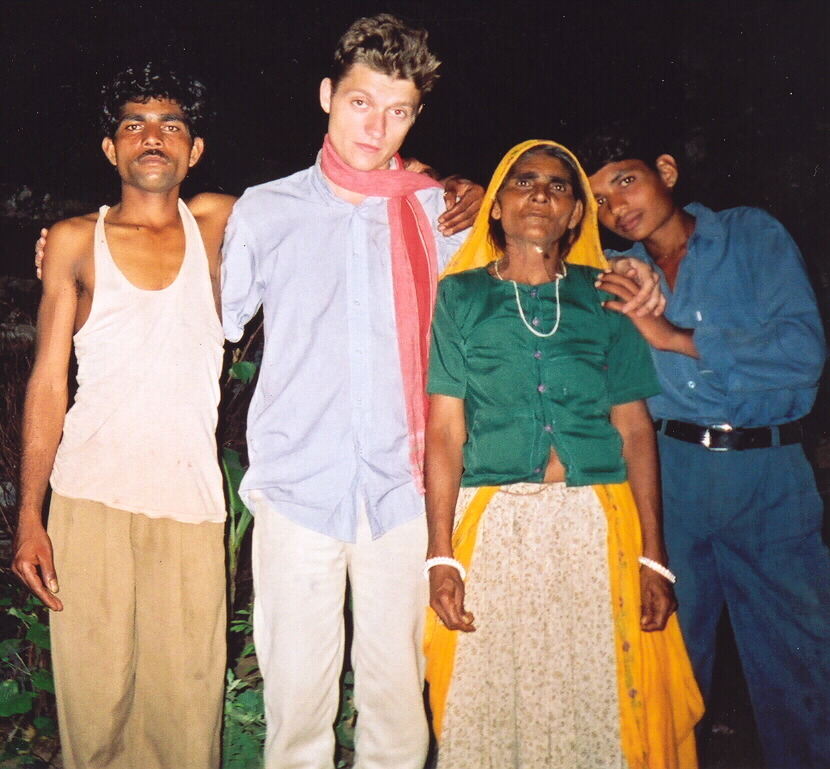
Chandni Chowk did not simply appear; it unfolded—layer upon layer—like a manuscript overwritten by centuries of touch, barter, devotion. Not a marketplace, but a living palimpsest, where movement itself seemed archival. I entered its crowded arteries with the uneasy conviction that I had already seen too much and understood too little: spectacle accumulating beyond the threshold of comprehension, even as it beckoned me further inward.

The air, thickened by incense and heat, re-tuned the body before the mind could follow. Fatigue dissolved into suspension—a hovering awareness in which perception loosened from its ordinary habits. I felt myself lifted, though not cleanly: every ascent carried residue, a shadow of estrangement. I was at once within and outside the scene, participant and remainder, trailing the slow grammar of a rickshaw’s wheels as though rhythm itself might grant me belonging.¹

At the edge of a festival, a golden Trimurti seized the light. Its weapons—spear, shaft, sword—did not threaten but signified: theology rendered metallic, gleaming with condensed myth. Around me, the Siddhas’ mantras did not so much sound as permeate, entering the body as vibration rather than language. The sacred here refused declaration; it accrued in fragments, sedimentary, like meaning itself.²

Memory—or something like it—turned me toward the imagined stillness of the Deer Park, where light rests upon water as though thought might finally resolve into coherence. Yet even this interior landscape refused stability. Scripts—Tibetan, or resembling them—seemed to unscroll across the mind’s surface, their signs at once intimate and illegible. Reality felt stratified, dimensional, withheld: knowledge circulating in closed circuits, resistant to the profane act of naming.³

Such opacity did not clarify; it unsettled. I sensed structures—of authority, of transmission—but they appeared mediated through figures whose blindness seemed itself a form of sight. Who, here, reads? Who is permitted interpretation? The question was not abstract; it pressed itself into perception, revealing how vision is always already governed.⁴

In a moment of excess—when sensation threatened to outpace thought—I invoked Ganesha. Not as ritual propriety demands, but as an intuitive appeal: a figure of passage, of thresholds negotiated. What came to me was neither orthodox nor coherent—a peacock-drawn chariot of light, improbable and syncretic, bearing me across uncertain waters. Cultural forms, I realised, are never merely inherited; they are translated inwardly, reassembled under pressure.⁵

Yet the narrative would not resolve. I had been seeking an encounter—perhaps with a person, perhaps with an idea—that receded precisely as I approached it. This failure did not collapse into despair; it sharpened perception instead. To see more keenly, yet hear less clearly: such was the paradox of my movement through the bazaar.

And still, something persisted. A fleeting illumination—like light striking the interior of a cave—suggested not revelation but interruption: a momentary clearing within density. Compassion appeared not as doctrine, but as event, as sudden gift—unbidden, untheorised.

What remained was a desire for renewal—not escape, but reorientation. Spring, here, ceased to be seasonal and became ethical: a horizon against which the sediment of past perception—those ingrained programmes of seeing and knowing—might be rewritten. The journey, then, was not toward arrival, but toward a recalibration of sight itself.


Footnotes with Commentary (Theoretical). 

  1. This oscillation between participation and estrangement recalls phenomenological accounts of perception, in which the subject is never fully immersed in the world but constituted through a shifting relation to it. See Maurice Merleau-Ponty, Phenomenology of Perception (London: Routledge, 1962).
  2. On ritual as accretive rather than declarative, see Catherine Bell, Ritual Theory, Ritual Practice (New York: Oxford University Press, 1992), esp. the notion of ritualisation as a process rather than a fixed symbolic system.
  3. The experience of illegible yet affectively charged signs aligns with semiotic excess in post-structuralist theory, where meaning proliferates beyond stable interpretation. Cf. Jacques Derrida, Of Grammatology (Baltimore: Johns Hopkins University Press, 1976).
  4. The question of who “sees” and who interprets echoes Foucault’s linkage of knowledge and power, particularly in regimes of visibility. See Michel Foucault, The Order of Things (New York: Vintage, 1970).
  5. Cultural translation here operates not as faithful transmission but as creative misreading—a process analogous to what Harold Bloom terms clinamen, the productive swerve from precursor texts. See Harold Bloom, The Anxiety of Influence (New York: Oxford University Press, 1973).

Yet would the tale not end, nor yield me rest;
I follow’d still a shape that would not stay—
A shadow form’d of longing and misprize,
That fled as near I thought to make it mine.

No grief was there, but rather quicken’d sense:
Mine eye grew sharp, yet hearing fail’d me still;
For something spake, half-hidden in the dark,
Which I pursu’d, yet never might I learn.

And yet—there glanc’d, within that inward cave,
A sudden beam, by broken light made strange;
No law it taught, nor doctrine did it press,
But shew’d compassion quick as lightning’s gift.

A brightness there, that brake the enclosing shade,
Not long abiding, yet enough to mark
That even in depths where wandering spirits move,
Some grace may strike, unbidden and unearn’d.

Then turn’d I hence, desiring not an end,
But motion—change—and time’s renewing wheel:
To feel again the pulse of season’d earth,
Where loss gives way to alteration’s course.

For Spring I sought—not reckon’d by the year,
But as a field wherein the mind might mend;
Where former shapes, long graven in the thought,
Might be unloos’d, and written o’er anew.


error: Content is protected !!